
Custer County Release Date Meaning
A projected release date is a calculated date. It is not a promise. An actual release date is the date the person left the reporting custody. A parole eligibility date is the date a person may be considered for parole. A discharge date is the end of a sentence or supervision term. Those dates can be close together, far apart, or controlled by different agencies.
For Custer County, the first question is whether the person is a pretrial detainee, county jail sentenced inmate, state prisoner, federal prisoner, probationer, or parolee. A pretrial detainee usually has no fixed release date because release depends on bond, court order, dismissal, or other legal action. A county jail sentence is controlled by the court order, jail credit, presentence confinement credit, statutory deductions, holds, and the jail record. A CDOC sentence is calculated by the state prison system.
Scheduled release is an estimate. Actual release must be confirmed through the custody agency or court record.
Find Custer County Release Date
The right search path depends on custody type. CDOC offender search is not the correct tool for a short Custer County jail release unless the person was sentenced or transferred to state prison. Likewise, a Fremont booking call will not calculate a prison release date. Start with the system that actually has custody or sentence authority.
- For a recent Custer arrest, search Colorado VINE and call Fremont Intake/Booking at 719-276-5555 option 2.
- Check the Custer Combined Court docket for bond, sentence, mittimus, probation, dismissal, warrant, or other release-related court action.
- For a state-prison sentence, use CDOC offender search by DOC number or name and compare identifiers.
- For parole timing, check the CDOC offender record and the parole-board calendar, then confirm the result through CDOC status.
- When the date is not online, request the release record, booking sheet, mittimus, or sentence calculation from the agency that holds it.
For notification of a pending or completed custody change, use VINE Inmate Check. For one-person release research that is not date-specific, use Custer County released inmates.
CDOC Custer Release Dates
CDOC offender search covers people sentenced to Colorado state prison. It is not a county jail roster. A Custer County felony can begin with local arrest and Fremont detention, then move to CDOC after sentencing. Once that happens, CDOC may become the public search path for custody status, parole, projected or tentative release date, mandatory release, and discharge.
| Search field | Use | Custer County note |
|---|---|---|
| DOCNO | Best exact match when known | Use from court, CDOC, or prior records if available. |
| Last name | Name search | Compare identifiers because names can repeat. |
| First name | Narrows a name search | Try spelling variations when needed. |
| Gender | Optional narrowing field | Do not use it if it could exclude a possible match. |
A current facility means the person is not released from CDOC. A parole entry can mean release from prison custody but continued state supervision. A discharge status means the state sentence or supervision has ended. Read CDOC status with the Custer court case when sentence or transfer history matters.
The public CDOC search page proves the search fields, but the exact projected or tentative release-date label appears on individual records and can vary by record display. Treat that field as a snapshot. If a date is close, confirm it with CDOC records, the case manager path where appropriate, VINE notification when custody is reported there, or the Custer court file when the sentence came from Custer Combined Court.
Custer County Jail Time
Current county-jail release-date computation for a Custer detainee is practically tied to Fremont County Detention Center because Custer's jail is closed. The legal authority still comes from the court sentence, the mittimus, jail credit, presentence confinement credit, any holds or detainers, and Colorado jail deduction law. The research does not support a fixed local public formula beyond the statute and agency records.
Colorado's current jail deduction statute is C.R.S. 17-26-109. It provides a seven-day deduction for each thirty days of a county-jail sentence when assigned duties are performed and rules are followed, calculated pro rata from the start of sentence and subject to forfeiture. It also allows an additional three-day deduction for certain approved program, education, trusty, or work activity. Older C.R.S. 17-26-115 trusty-prisoner good time is repealed and should not be treated as current authority.
For a Custer County misdemeanor or short jail sentence, the most useful records are the sentencing order, the jail record, and any release record from Fremont. Those records can show the sentence start, credited time, deductions, forfeitures, holds, or transfer reason. A public web search may not show the calculation, so the records request should ask for the date and release basis rather than asking for every jail file.
- Presentence confinement credit
- Credit for qualifying time already spent in custody before sentence.
- Jail deduction
- A statutory reduction applied to a county jail sentence when requirements are met.
- Detainer
- A hold or request from another agency that may prevent community release.
- Mittimus
- The court commitment order that tells the custody agency how to hold or transfer the person.
Colorado Earned Time Rules
State-prison release dates use CDOC sentence calculation, not a Fremont jail calculation. C.R.S. 17-22.5-405 allows earned time for eligible inmates based on consistent progress in work, training, group living, counseling, education, and program categories certified by CDOC staff. It allows up to ten days per month in the general structure, with up to twelve days per month for certain lower-level felony or drug felony categories when statutory conditions are met. It also includes credential and degree provisions for nonviolent felony offenses.
C.R.S. 17-22.5-403 governs parole eligibility for post-1993 felony sentences and allows extension for misconduct. For certain violent offenses, eligibility is date- and offense-sensitive. C.R.S. 17-22.5-303.3 covers specified pre-2025 violent-offender rules, and the Colorado General Assembly's HB24-1127 page summarizes the move from 75 percent less earned time to an 85 percent concept for covered offenses. Do not apply the 85 percent idea to all Colorado inmates.
The Colorado General Assembly HB24-1127 page is the matched source for that truth-in-sentencing context.
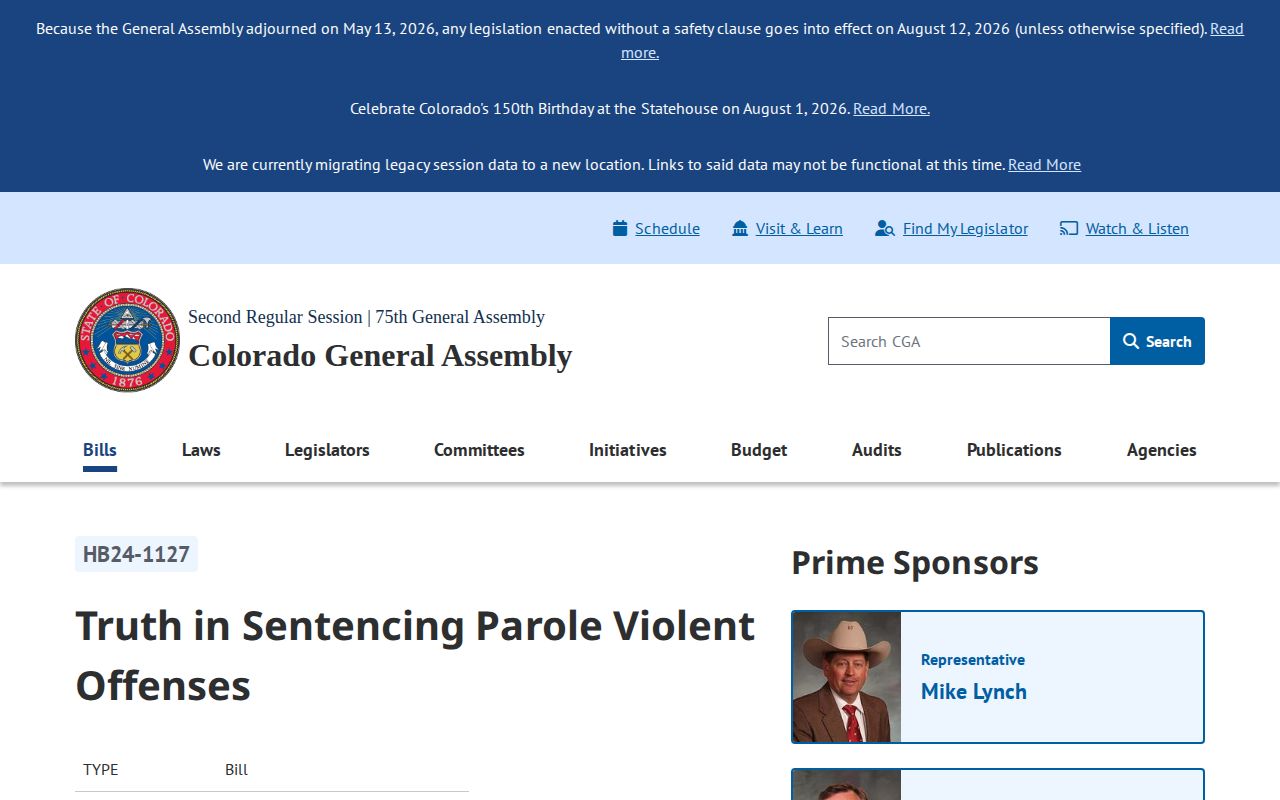
Use offense date and offense category when reading any 75 percent or 85 percent release-date statement.
Why Custer Release Dates Change
Projected dates can change after a user first sees them. A date may move because the court changes the sentence, jail credit is corrected, earned time is awarded or lost, misconduct affects parole eligibility, a detainer appears, or a parole decision changes the release path. The receiving agency matters too. A county release to CDOC is not community release.
| Change | Effect on release date |
|---|---|
| Jail credit correction | Can move a county or prison release date earlier or later. |
| Earned time awarded or forfeited | Changes sentence calculation under jail or CDOC rules. |
| Misconduct | May affect parole eligibility or deductions. |
| New warrant or detainer | May block community release even when the local sentence ends. |
| Parole-board action | Can grant, defer, deny, rescind, or revoke a release path. |
| Transfer to CDOC, ICE, BOP, or another county | Turns a local jail release into another agency's custody event. |
Confirm Custer Release Date
Confirmation means matching the date to the right custody event. VINE can alert to a release or transfer. Fremont booking can confirm current detention status. The Custer court docket can show bond, sentence, dismissal, mittimus, or probation. CDOC can show prison status, parole, or discharge. BOP or ICE applies only when the case moved into federal or immigration custody.
When the date still is not clear, request the record. For Fremont detention records, use the records page and include a signed request with ID. For Custer agency records, use the county public-records request form. Ask for the release date and time, release type, holding agency, bond paperwork if applicable, transfer destination, and the booking number or case number.
A date can also be wrong because the wrong system was checked. CDOC will not calculate a release date for a person who only served a short county jail sentence. Fremont will not calculate a prison parole eligibility date. VINE can show a custody change without explaining sentence math. Matching the date to the right agency prevents those errors.
For a future date, ask whether the date is projected, eligible, mandatory, scheduled for transport, or already completed. Those labels answer different questions. A projected CDOC date can move. A bond release may depend on posting and return to the jail. A court transport date may not be community release at all.
Note: A release date can confirm physical custody only. It does not always prove that probation, parole, or court obligations are complete.